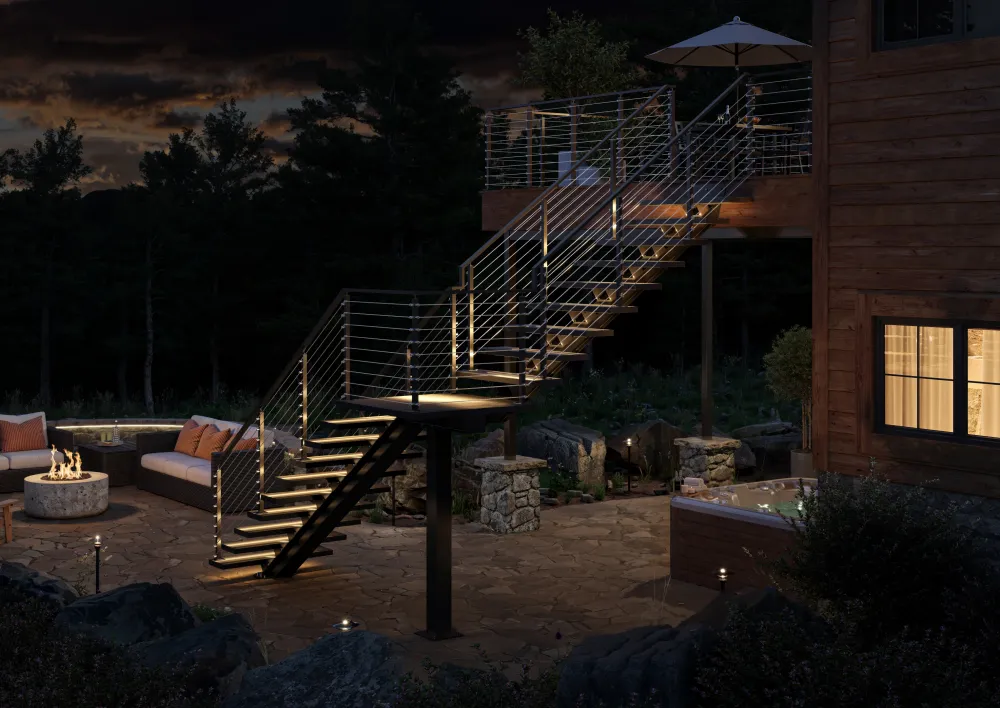
Floating Staircases in Virginia
Virginia's residential market spans a wide range of architectural styles and building eras. Northern Virginia's suburbs include colonial revivals, transitional new builds, and contemporary custom homes in areas like McLean, Great Falls, and Alexandria. Glass staircases and floating stair designs continue to redefine interior aesthetics in Fairfax, Springfield, and Annandale homes, offering more than just a path between floors and creating architectural statements that maximise natural light. Further south and west, the housing stock shifts toward larger lots, newer construction, and more varied architectural styles that suit a wider range of stair design approaches.
Modern homes in Great Falls and the wider Northern Virginia area often feature solid walnut or steel staircases as central organisational elements, connecting multiple levels and shaping the flow of the entire interior. In these larger custom homes, the staircase is rarely an afterthought. It gets engineered and designed as part of the structural framework from the beginning, because the floor-to-floor heights, landing configurations, and wall materials are all decided at the same time as the stair.
Northern Virginia homeowners in 2026 increasingly want homes where every space is intentional, using natural light, intuitive flow, and strong indoor connections to support how they live day to day. A floating staircase addresses all three of those priorities. The open-riser layout allows light to travel between levels. The cantilevered or mono stringer structure removes the visual mass of a traditional enclosure. And the steel frame ensures the staircase functions without bounce, vibration, or visible movement after years of daily use.
Custom fabrication, white-glove installation, and glass or cable railing systems are all relevant across Northern Virginia's housing market. Alexandria's renovated townhouses, much like DC's rowhouses, carry older wall construction that requires site-specific structural assessment before a cantilevered system can be anchored correctly. McLean and Great Falls custom builds, on the other hand, often have concrete or reinforced masonry walls that accept chemical anchor bolts at full rated capacity, simplifying the anchor schedule and shortening the installation sequence.
Virginia's building permit process for staircase work falls under the Virginia Uniform Statewide Building Code, which adopts the IBC with state-specific amendments. Floating staircases must meet the same structural and safety standards as any other staircase, with concealed structure, balustrades, and handrails properly designed and installed. For a cantilevered stair anchored to an existing wall in Northern Virginia, that means stamped structural drawings, an anchor schedule with embedment depths and torque specifications, and a deflection check for both the stringer and individual treads at the required live load of 100 pounds per square foot.
Virginia's colder winters also require special consideration for thermal contraction in exterior applications, with structural systems strengthened to accommodate seasonal movement and variable load conditions. For any stair with an outdoor component, these factors must be built into the engineering framework from the start.
Our team applies Virginia's statewide building code requirements and permit documentation standards to every project across the state. We coordinate structural drawings, anchor schedules, and permit submissions as part of the standard project process, so inspections run on schedule without last-minute corrections.
Areas We Cover
Arlington
Great Falls
McLean
Fairfax
Herndon
Reston
Falls Church
Alexandria
Start Your Virginia Staircase Project
Our team applies Virginia's statewide building code requirements and permit documentation standards to every project across the state.